
A personalised approach to meniscus and knee treatment

Orthopaedic Surgeon

Clinical Nurse Specialist

Care Coordinator

Physiotherapist Coordinator
A meniscus tear is an MRI finding, but treating a knee involves more than treating a scan. The right treatment depends on your symptoms, examination findings, the type of tear, the condition of the rest of your knee and what you want to get back to doing. For many people, good rehabilitation is all that is required. For others, particularly those with an acute repairable tear or a displaced tear causing mechanical locking, surgery may be appropriate. The aim is to preserve the knee wherever possible, restore function and choose the least invasive treatment that is likely to provide a meaningful benefit.
Dr Dan Fick - Orthopaedic Surgeon
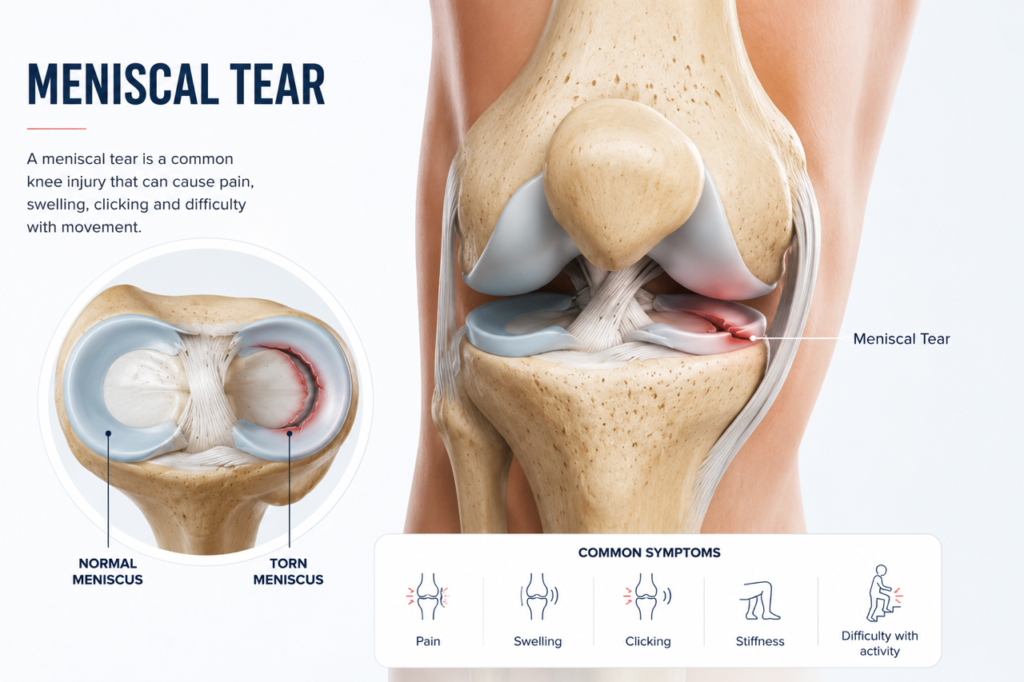
The meniscus, knee and meniscal damage
The meniscus is a C-shaped structure made from fibrocartilage that sits between the femur (thigh bone) and tibia (shin bone).
Each knee has a medial meniscus on the inner side of the joint and a lateral meniscus on the outer side.
Each meniscus plays several important roles. They help distribute load across the knee, absorb shock, contribute to joint stability and protect the articular cartilage.
Have I torn my Meniscus?
A meniscal tear is one of the most common knee injuries, affecting everyone from athletes to those with age-related degenerative change.
It can happen suddenly often when the knee twists or pivots with the foot planted or develops gradually as the meniscus weakens over time.
The impact varies widely: some tears cause little or no trouble, while others bring persistent pain, swelling, catching or restricted movement.
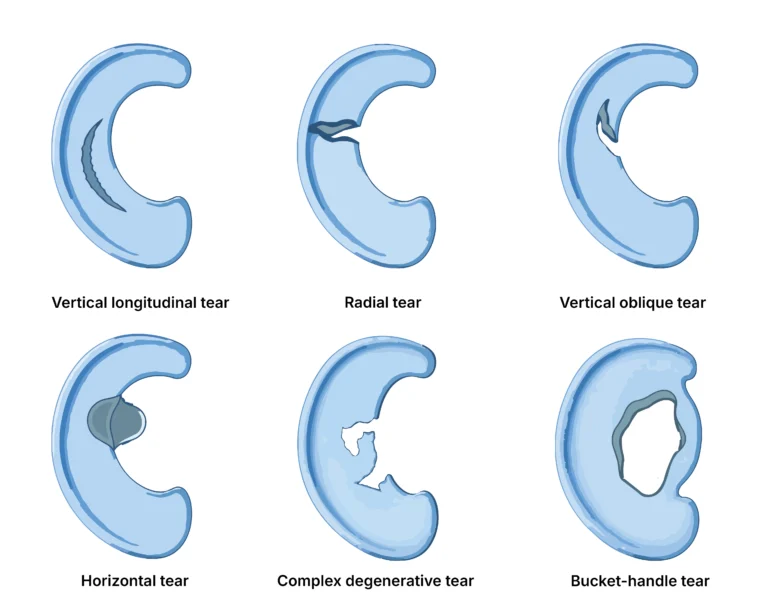
Importantly, seeing a tear on an MRI doesn't automatically mean surgery is needed. Treatment depends on the type of tear, your symptoms, the overall health of your knee, and how it's affecting your day-to-day function and quality of life.
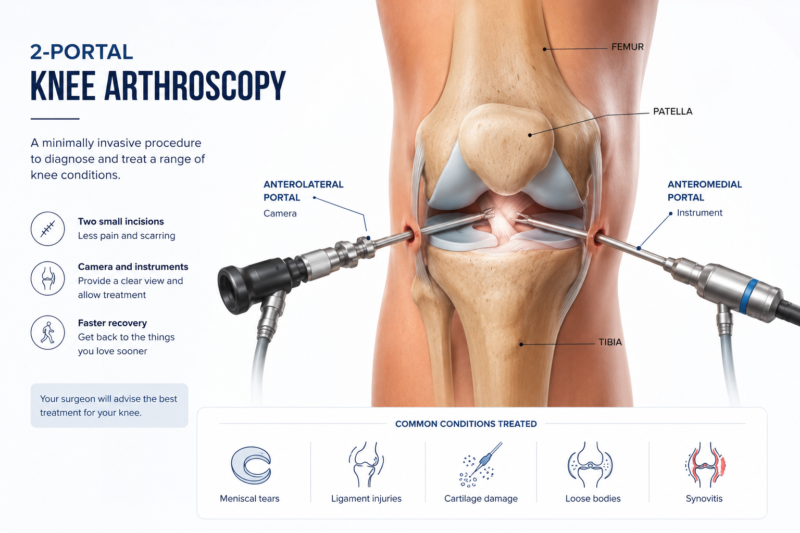
Arthroscopy for meniscus repair
We use two small incisions either side of your knee to access your joint.
An arthroscope (tiny camera) is inserted through one of the incisions to allow Dan to see inside your knee, which means it is a minimally invasive surgical operation.
When a tear has suitable characteristics and a reasonable potential to heal, the meniscus may be repaired using specialised fixation devices.
The repair preserves meniscal tissue and is particularly important in younger patients and active people when the tear pattern is suitable.
Not every meniscus tear can be repaired. The decision depends on factors including the location and pattern of the tear, tissue quality, blood supply and the overall condition of the knee.
Medial meniscus tears
The medial meniscus is located on the inner side of the knee and is injured more commonly than the lateral meniscus. Because it is relatively less mobile, it can be more vulnerable during twisting and rotational movements.
Medial meniscus tears can occur as an isolated injury or in association with other knee injuries, including anterior cruciate ligament (ACL) injuries. They are also commonly seen as part of the degenerative changes that occur in the knee with age.
Lateral meniscus tears
The lateral meniscus sits on the outer side of the knee and is more mobile than the medial meniscus.
Lateral meniscus tears may occur during pivoting sports and can also accompany ACL injuries. The pattern, location and stability of the tear are important considerations when deciding whether treatment should involve rehabilitation alone or whether surgery may have a role.
Symptoms of a meniscus tear
Symptoms vary depending on the type of tear and whether there are other problems within the knee.
Common symptoms can include:
Pain around the inner or outer joint line
Swelling, which may develop gradually after an injury
Stiffness or reduced movement
Pain with twisting, pivoting or deep squatting
Clicking or catching sensations
Difficulty fully straightening the knee
A feeling that the knee is unreliable or giving way
Clicking or occasional catching does not necessarily mean that surgery is required.
A knee that becomes genuinely locked, particularly when it cannot be fully straightened, is different and should be assessed promptly. This can sometimes occur when a displaced fragment of meniscus mechanically blocks movement of the knee, sometimes called a bucket-handle tear.
How is a meniscus tear diagnosed?
If you experience any of the symptoms above, or suspect a possible meniscus or knee injury, a proper diagnosis starts with a discussion of your symptoms and how the problem developed, followed by a clinical examination to assess movement, tenderness and stability in the knee.
X-rays are often useful, especially for gradual-onset symptoms, to check for osteoarthritis or other contributing changes, while an MRI may be added if the diagnosis is unclear, a significant injury is suspected, or the result would change treatment.
Because MRI is highly sensitive and often detects meniscal tears especially with age, its findings should always be interpreted alongside your symptoms and examination, not in isolation.
The aim is not simply to treat what appears on the MRI it is to understand what is causing your symptoms and choose the treatment most likely to improve your function.
Treatment for a meniscus tear
Many meniscus tears can be successfully managed without surgery.
Initial treatment will depend on the circumstances but may include:
Modifying activities that aggravate the knee
Ice and simple measures to manage swelling following an acute injury
Physiotherapy and an individualised exercise program
Improving strength and control around the knee, hip and lower limb
Appropriate pain relief or anti-inflammatory medication where suitable
Gradual return to work, recreation or sport
When might surgery be considered?
Surgery is not necessary for every meniscus tear.
It may be considered when there is a repairable acute tear, a displaced tear causing true mechanical locking, persistent symptoms despite an appropriate period of non-operative treatment, or when the meniscus injury occurs alongside another knee injury that requires surgery, such as an ACL reconstruction.
The decision to operate should take into account:
The type and location of the tear
Whether the tear is acute or degenerative
The condition of the cartilage and the rest of the knee
Your symptoms and functional limitations
Your age and activity requirements
Your response to rehabilitation
Your individual goals and expectations
Where surgery is appropriate, preserving as much healthy meniscus as possible is an important principle.
Meniscus repair
When a tear has suitable characteristics and a reasonable potential to heal, the meniscus may be repaired using sutures or specialised fixation devices.
Repair preserves meniscal tissue and is particularly important in younger patients and active people when the tear pattern is suitable.
Not every meniscus tear can be repaired. The decision depends on factors including the location and pattern of the tear, tissue quality, blood supply and the overall condition of the knee.
Partial meniscectomy
When a damaged or unstable portion of meniscus cannot be repaired and continues to cause significant symptoms, a limited amount of damaged tissue may occasionally need to be removed. This is called a partial meniscectomy.
The goal is to remove only the unstable tissue while preserving as much healthy meniscus as possible.
This is important because loss of meniscal tissue increases the load transmitted through the knee and is associated with an increased risk of degenerative change over time.
Should a meniscus tear be treated early?
Not every meniscus tear requires urgent treatment, and many can initially be managed with rehabilitation.
There are, however, some situations where earlier orthopaedic assessment is appropriate. These include a knee that is genuinely locked and cannot fully straighten, a significant acute injury with ongoing instability, or symptoms suggesting a displaced meniscal tear.
Early assessment in these circumstances can be important because some acute tears may be suitable for meniscal repair.
For more gradual or degenerative symptoms, the priority is usually to establish what is driving the pain and whether the meniscus, osteoarthritis or another part of the knee is primarily responsible.
Recovery after meniscus surgery
Recovery depends largely on the procedure performed.
Following a partial meniscectomy, weight bearing and movement can usually progress quickly, with many people returning to everyday activities within a few weeks though this varies by individual and physical demands.
Recovery after a meniscus repair is deliberately slower, as the repaired tissue needs time to heal. This may involve crutches and restrictions on weight bearing or knee flexion early on, with physiotherapy progressing through movement, strength, balance and functional training.
Return to sport and demanding activities is individualised, guided by healing time and rehabilitation milestones rather than a fixed date.
Interesting facts about your meniscus
The meniscus is much more than a simple shock absorber. Here are a few things about the menisci that often surprise patients:
You have four menisci. There are two in each knee: the medial meniscus on the inside and the lateral meniscus on the outside.
The meniscus helps spread your body weight across the knee. By increasing the contact area between the femur and tibia, the menisci help distribute forces rather than concentrating them onto a small area of joint cartilage.
The outer and inner parts of the meniscus have very different healing potential. The outer portion has a better blood supply and therefore a greater capacity to heal. The inner portion has very little blood supply, which is one reason some tears are more suitable for repair than others.
The lateral meniscus moves more than the medial meniscus. This extra mobility helps it accommodate the movement of the outer side of the knee during bending and rotation.
A meniscus tear on an MRI does not necessarily mean it is causing your pain. Meniscal changes and tears become increasingly common on MRI as we get older and can be present in people who have no knee symptoms at all.
A torn meniscus does not automatically need surgery. Many tears, particularly degenerative tears, can be successfully managed with rehabilitation, strength training and appropriate modification of activity.
Saving meniscus tissue matters. The meniscus helps protect the articular cartilage of the knee. Modern meniscus surgery therefore places much greater emphasis on repairing and preserving meniscal tissue wherever appropriate rather than simply removing the torn portion.
Removing meniscus changes the mechanics of the knee. The less functioning meniscal tissue remaining, the greater the contact stresses transmitted through the joint. This is one reason surgeons try to preserve as much healthy meniscus as possible.
Meniscus tears and ACL injuries are closely related. Meniscal injuries commonly occur at the same time as an ACL rupture. The menisci also contribute to knee stability, particularly when the ACL is deficient.
Not all clicking is a meniscus problem. Knees commonly click, pop and make noise without there being a significant meniscal injury. Symptoms, examination and imaging need to be considered together.
A truly locked knee is different from a knee that simply feels stiff. A displaced meniscal tear, including some bucket-handle tears, can physically prevent the knee from fully straightening. This warrants earlier assessment.
Your meniscus is designed to work under load. Once it is safe to do so, appropriate movement, muscle strengthening and progressive loading are important parts of rehabilitation rather than simply resting the knee.
The take-home message
A meniscus tear is not just a question of whether there is a tear on an MRI. The type of tear, where it is located, the condition of the rest of the knee and how it is affecting you are usually far more important.
Our goal is to treat the person and the knee, not simply the scan.
Most of the adult meniscus has essentially no blood supply. Vascularity retreats towards the periphery during development, leaving roughly the inner two thirds largely avascular. This creates the familiar red-red, red-white and white-white zones relevant to healing and repair.
The meniscus is built more like a suspension structure than a cushion. Its circumferential collagen fibres convert compressive forces from the femur into circumferential “hoop stresses”. The intact peripheral attachments prevent the meniscus from simply being squeezed out of the joint.
Its collagen architecture is remarkably specialised. Predominantly type I collagen fibres run circumferentially, while smaller radial fibres act rather like ties, helping prevent the meniscus from splitting longitudinally under load.
The meniscus has its own sensory system. The peripheral meniscus contains mechanoreceptors and nerve endings that contribute to proprioception. So the meniscus does more than manage load. It may actually help the brain understand where the knee is in space.
A meniscal root tear can biomechanically behave surprisingly like losing the meniscus. If the root attachment is disrupted, the meniscus can no longer generate normal hoop tension. Despite much of the tissue still being physically present, its ability to distribute load can be dramatically impaired.
"Having meniscus surgery is a big decision. Please ask us anything at any stage of your journey. Our team has many years of experience in orthopaedic care and we'll be with you every step of the way."
Dr Dan Fick
Orthopaedic surgeon
Dan Fick’s office is located within the Hollywood Medical Centre in Nedlands, Perth
